Tuscany, is not only famous for its history, art and culture, but also for its vibrant traditions and festivities. Among the most special and significant events are some historical festivals that attract visitors from all over the world. Let's discover together some of the traditional Tuscan festivities that you cannot miss.
Posted in: Tuscany
Festivals in Tuscany: Historical events that Illuminate the region
Publication Date Wednesday, June 28, 2023
Giulia
Palio of Siena
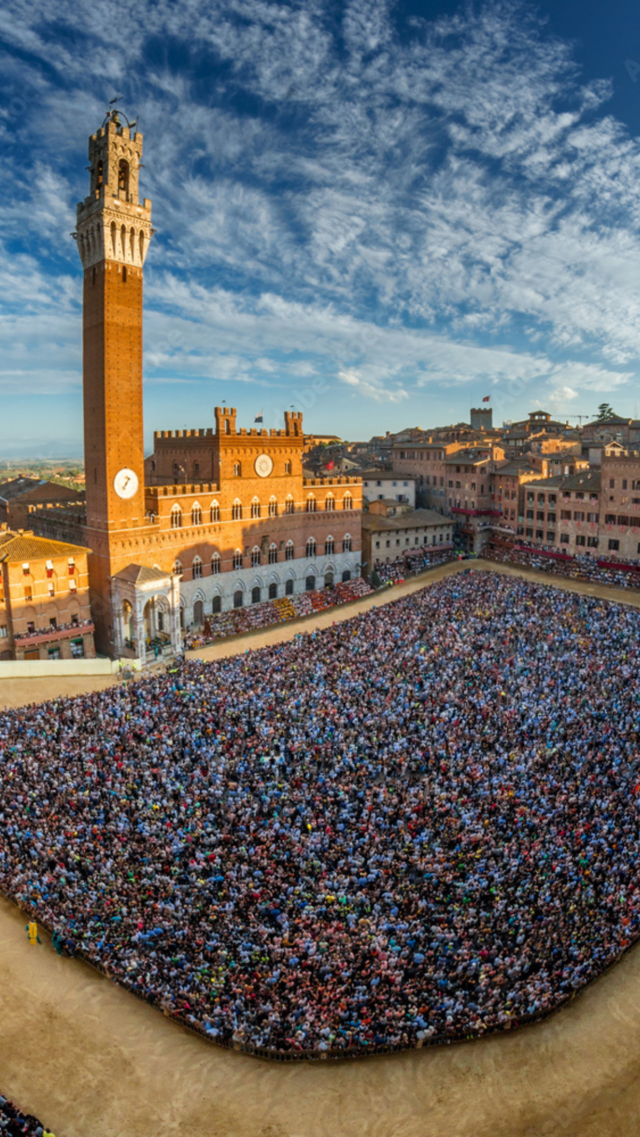
One of the most fascinating events steeped in history in Italy. This exciting horse race takes place every year in July and August: on 2 July with the Palio in honour of the Madonna di Provenzano and on 16 August with the Palio in honour of the Madonna dell'Assunta in the picturesque city of Siena, Tuscany, and involves the city's seventeen historic contrade.
Each contrada represents a district and has a unique name, symbol, colour and flag. Among the most famous contrade are the Bruco, Chiocciola, Istrice, Oca, Nicchio, Drago, Lupa, Aquila, Leocorno, Giraffa and many others. Each of them has a rich history and a strong sense of belonging.
The Palio race takes place in the beautiful Piazza del Campo, one of the most iconic places in Italy. The square is transformed into an arena, with a dirt track surrounding the square itself. Jockeys, skillfully leading their saddle-less horses, bareback compete in three frantic laps around the square.
The Palio di Siena is much more than just a horse race. It is an event that involves the entire city, with processions, historical parades and ceremonies taking place in the days leading up to the race. Each contrada participates in the celebrations with enthusiasm and fighting spirit, supporting its jockey and hoping to bring home the victory.
One of the most fascinating events steeped in history in Italy. This exciting horse race every year in July and August: the Palio on 2 July
Victory in the Palio di Siena is highly coveted and is celebrated with great joy and festivity. The winning contrada receives a precious painted cloth, the Palio banner, which is proudly displayed in the district throughout the year.
The Palio di Siena is a unique event that attracts visitors from all over the world. Its centuries-old traditions, enthralling atmosphere and palpable energy make it an unforgettable experience. If you wish to immerse yourself in the history and passion of this extraordinary event, be sure to plan your visit during one of the two Palios per year.
Calcio Storico
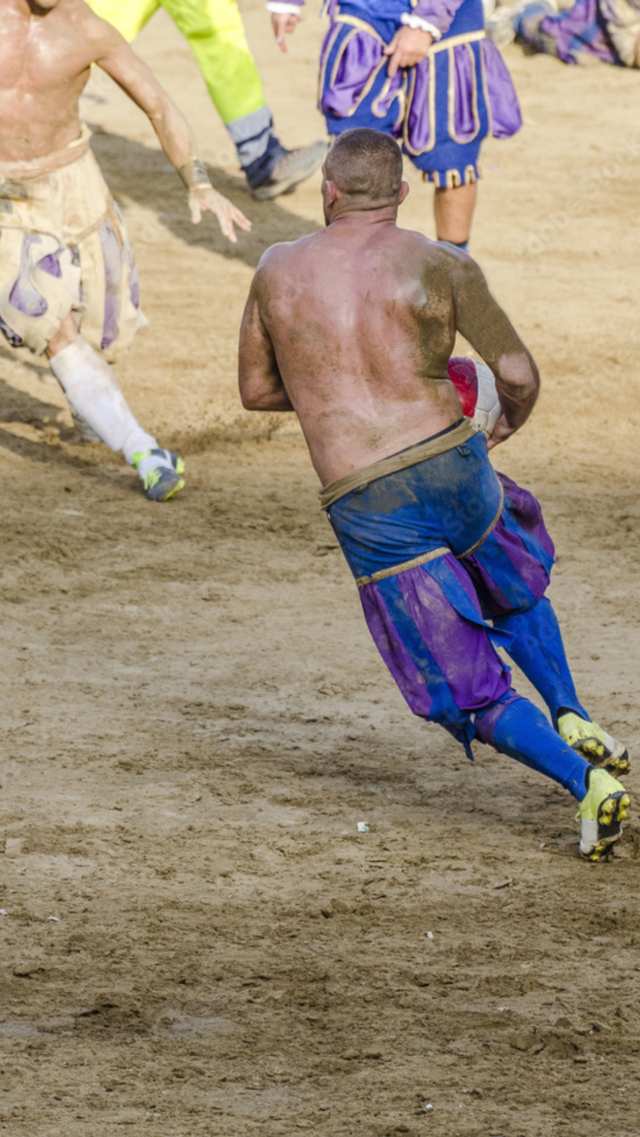
Calcio Storico is a unique and fascinating sport that combines elements of football, rugby and wrestling. Originating in Florence in the 16th century, the game is played between the four teams representing the city's historical quarters: Santa Croce (blue), Santo Spirito (white), Santa Maria Novella (red) and San Giovanni (green).
The square of Santa Croce, located in front of the church of the same name, is the epicentre of this exciting competition. The square is set up as in the past, covered with sand. The stands are organised so that spectators can enjoy the spectacle to the fullest.
The rules of Calcio were first published in 1580 by Giovanni de' Bardi, a Florentine count. Initially reserved for the aristocratic elite, the game was played every night before Epiphany and Lent. The teams, each consisting of 27 players, could use both feet and hands to score points. The game lasts 50 minutes and the team with the most points, also called 'hunts', wins.
The winning teams compete in the final, which is always played on 24 June, the day of St John the Baptist, the patron saint of Florence. A magnificent parade in historical costumes goes through the streets of the centre, involving all four teams, even those not participating in the final. The day ends with a fireworks display on the banks of the Arno, providing a light and colourful spectacle to worthily conclude the event.
Calcio Storico is more than just a sporting competition. It is an experience that transports you back in time, allowing you to experience the enthusiasm, energy and passion surrounding this centuries-old tradition. It is a unique way to immerse yourself in the history and culture of Florence, and to appreciate the deep connection between the city and its sporting heritage.
Luminara of Pisa
The Luminara di San Ranieri is the most eagerly awaited moment of the year for the people of Pisa, a festival that envelops the entire city in a wonderful dress of lights. Every 16 June, even in the rain, Pisa lights up with 100,000 wax candles, arranged on wooden frames along the Lungarni, outlining the architecture of the palaces and churches. The reflection of the lights on the river creates a magical effect that makes the spectacle even more impressive.
The lighting of the candles starts at 3 pm along the Lungarni, from the Ponte della Cittadella to the Ponte della Fortezza. At dusk, the public and private artificial lights go out, immersing the Lungarni in the magic of San Ranieri's evening.
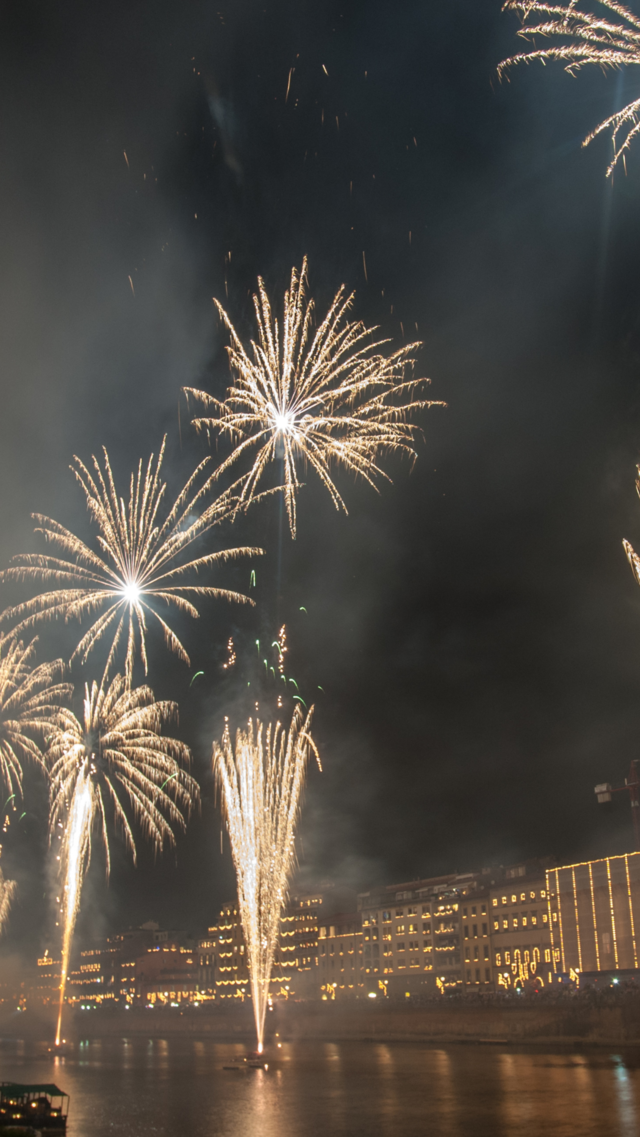
Around 11 p.m., hundreds of spectacular fireworks illuminate the skies of Pisa. Floating platforms along the Arno serve as bases for the fires, transforming the entire city into a dazzling beacon that will remain etched in the memories of those who witness it.
The tradition of the Luminara dates back to 1688, when the urn containing the body of Ranieri degli Scaccieri, patron saint of Pisa, was solemnly placed in the cathedral chapel. Since then, this triennial celebration, which has become known as the Luminara, has become increasingly important in the city's tradition, representing an indispensable moment to strengthen the sense of belonging to one's city. The Luminara is just one of the events that animate the Giugno Pisano, a period rich in festivities and celebrations.
The Luminara di San Ranieri is a unique experience that allows one to immerse oneself in the beauty and tradition of Pisa. It is a moment when the city lights up with joy and pride, creating an unforgettable atmosphere for its inhabitants and visitors.
The Carnival of Viareggio
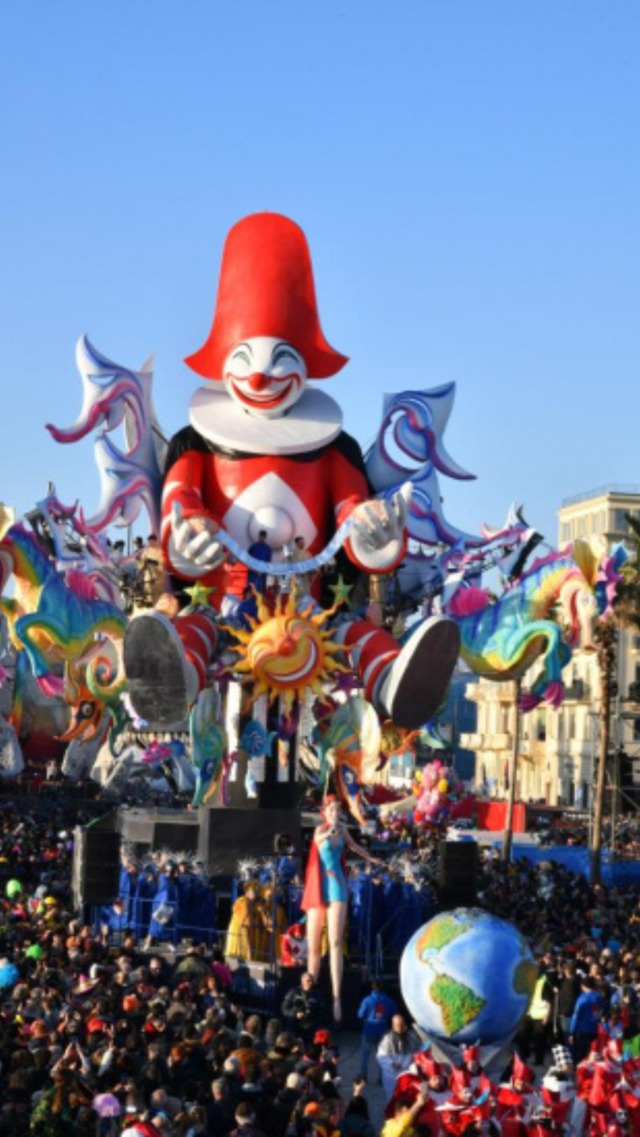
is a celebration of pure joy and fun. Every year, Viareggio's Passeggiata Margherita prepares for the parade of carnival floats in the afternoon and then continues to celebrate in the evening in the districts.The reason Carnival is celebrated is linked to the tradition of celebrating before the period of Lent, a period of fasting and renunciation preceding Easter.
Carnival offers the opportunity to indulge in the joys of life, unbridled fun and unrestricted creativity. The Viareggio Carnival, born in 1873, has become a spectacular event over the years. From its beginnings with flowery floats, it has evolved with majestic allegorical floats; true artistic masterpieces that parade through the streets of the city. These floats are skilfully constructed using the papier-mâché technique, which allows for the creation of incredible and detailed structures. Each float is a work of art in itself, often with satirical or symbolic themes that reflect contemporary society and culture.
The costumes worn during Carnival are equally spectacular. People dress up in imaginative and colourful outfits, transforming themselves into fairy tale characters, heroes, animals or historical figures. Imagination and creativity are free to express themselves through costumes, creating a magical and engaging scenario.During Carnival, one cannot forget to savour the sweets typical of this feast. Among the most famous are chiacchiere and fritters with rice and sultanas. These delicacies are available in every corner of the city and are an integral part of the Viareggio Carnival experience. The Viareggio Carnival is a magical and enthralling event that fascinates visitors from all over the world every year. With its extraordinary floats, creative costumes and typical sweets. It is a festival that celebrates fantasy, tradition and light-heartedness, transforming the town into a veritable spectacle of colours, music and merriment.
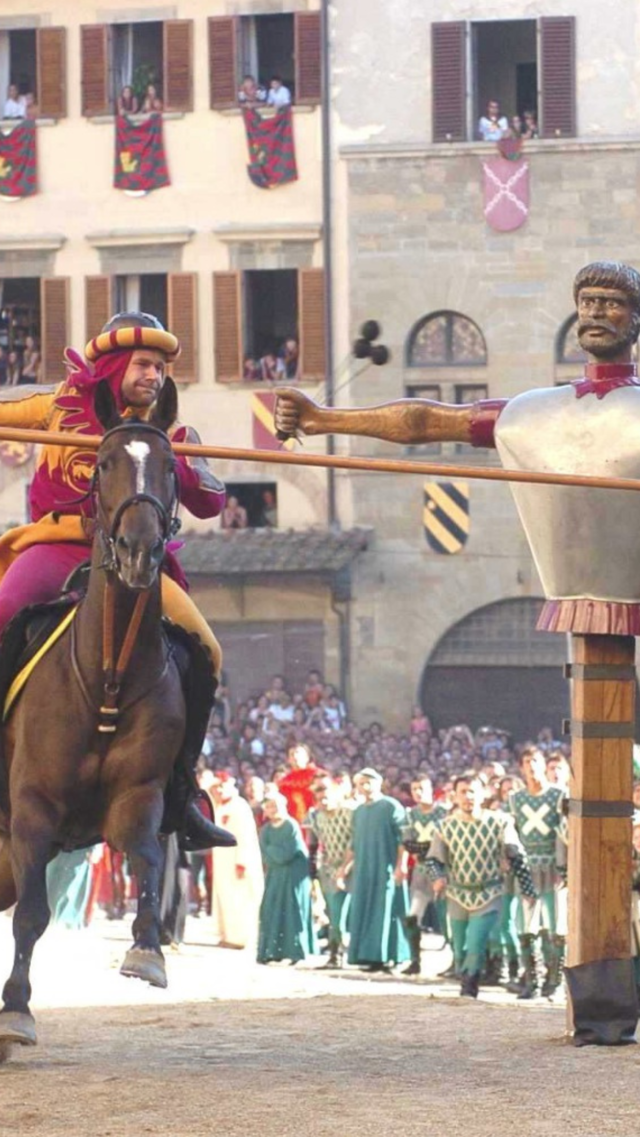
The Joust of the Saracen or Giostra del Saracino
The Giostra del Saracino of Arezzo is a historical and traditional festival held every year in the Tuscan city of Arezzo. This fascinating event has its roots in the Middle Ages. It is a competition in which horsemen belonging to the four quarters of Arezzo (Quartiere di Porta Crucifera, Quartiere di Porta del Foro, Quartiere di Porta Sant'Andrea and Quartiere di Porta Santo Spirito) challenge each other on horseback to demonstrate their skill in tackling a target representing the Saracen, a symbolic figure from ancient times. The objective is to hit the target with a lance, thus demonstrating dexterity and precision.
The event takes place in Arezzo's picturesque Piazza Grande, which is transformed into a medieval arena with stands for the public. The knights, dressed in traditional costumes and accompanied by flag-wavers and musicians, parade through the streets of the city, creating an atmosphere of celebration and involvement.
The actual joust is held in the centre of the square, where the knights compete one after the other, trying to achieve the highest possible score. The competition requires skill, concentration and control of the horse as participants try to hit the moving target with their lances.
The Giostra del Saracino is more than just a competition: it is a moment of pride for the city of Arezzo and a celebration of its historical traditions. The event attracts numerous visitors from all over the world, fascinated by the spectacular nature of the joust and the unique atmosphere that permeates the city during this festival.
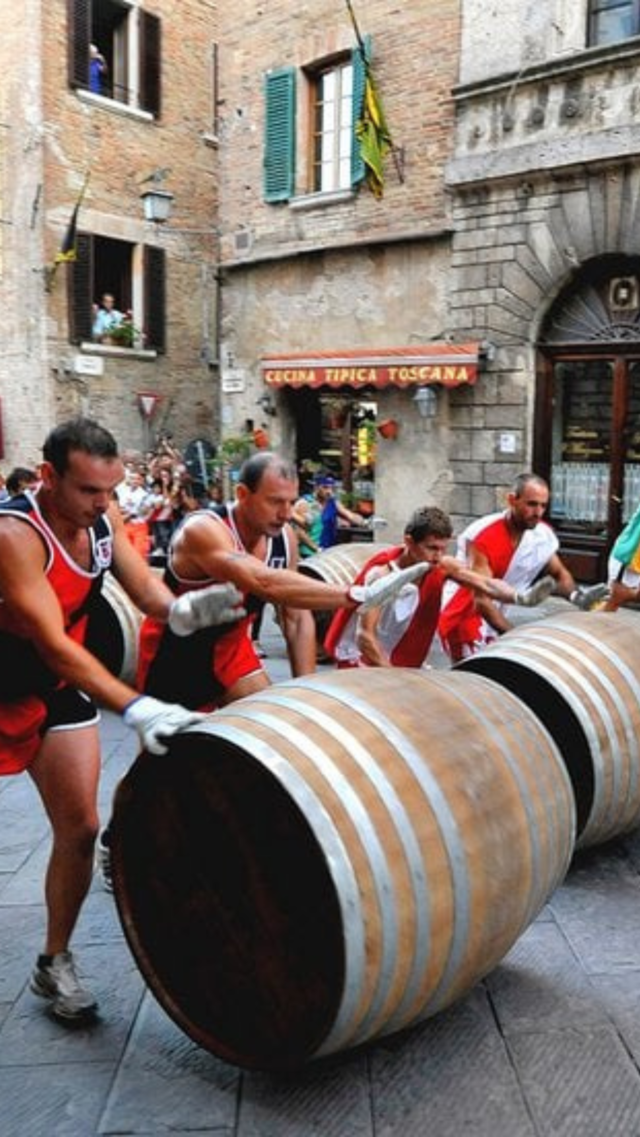
Bravio or Palio delle Botti di Montepulciano
In the picturesque town of Montepulciano, the Bravio, or Palio delle Botti, is held, a competition involving the town's eight contrade. During this competition, participants roll wooden barrels along the uphill streets of the town, in a course full of obstacles. The race is a demonstration of strength, skill and contrada pride that brings residents together and attracts numerous visitors. The Bravio delle Botti is an ancient and exciting competition held in the town of Montepulciano, Tuscany. This event, which dates back to the 14th century, pits the city's various districts against each other in a contest of strength and skill.
It takes its name from the wooden barrels that are rolled down the steep streets of Montepulciano. Each district selects two athletes, called 'spingitori' (pushers), who have to push the barrels up a roughly 1,800-metre uphill course until they reach the Piazza Grande, the heart of the city.
The competition is a mix of tradition, competitive spirit and popular celebration. Each district is represented by distinctive colours and supported by a large crowd of enthusiastic supporters. During the event, the streets are decorated in the colours of the districts and the inhabitants dress in traditional costumes.
Before the race, a solemn opening ceremony takes place with traditional parades, singing and dancing. Then, at the start, the two pushers take their places behind the barrels and, at the signal, the challenge begins. The crowd cheers and supports them along the entire route, as the barrels roll by at great speed, requiring the pushers to have considerable physical endurance and skill in controlling the direction.
The winner of the Bravio delle Botti is the district that completes the course in the shortest possible time. Victory is a great honour for the district, which celebrates its success with festivities and celebrations.
The Bravio delle Botti is a unique opportunity to immerse oneself in the history and traditions of Montepulciano, as well as to experience the enthusiasm and passion of the competition. It is an event that unites the community, creating a strong sense of belonging and pride in one's city and neighbourhood.